

Fun Facts About Mount Kilimanjaro
What Makes Mount Kilimanjaro So Special?
Kilimanjaro is one of the Great Landmarks of the world. In Tanzania, it is a massive, free-standing volcanic monolith that draws researchers, climbers, and nature lovers from around the globe. There are so many similar interesting facts about Mount Kilimanjaro that make it special and unique.
Let’s learn these facts and appreciate nature’s true masterpiece.

Snow-covered slopes of Mount Kilimanjaro during sunrise.
Interesting Facts about Mount Kilimanjaro
Tallest Mountain in Africa
This one is obvious, but it is still one of the most interesting facts about Mount Kilimanjaro. At an estimated 5,895 meters (19,341 feet), Kilimanjaro is the continent’s tallest mountain. It’s not the only peak of the mountain: Its summit is on a central cone, known as Kibo, and it has made news independently for being Earth’s highest free-standing mountain, meaning that it isn’t attached to other mountains as one range.
Three Volcanic Cones
This might be one of the Little-Known interesting facts about Mount Kilimanjaro for many. People are often shocked by the fascinating facts about Mount Kilimanjaro, such as its three distinct volcanic cones.
Yes, you read that right, Kilimanjaro isn’t just one volcano but three cones:
- Kibo (dormant)
- Mawenzi (extinct)
- Shira (extinct and eroded)
Disappearing Glaciers
The glaciers on Mount Kilimanjaro, an icy, photogenic cap that crowns Africa’s highest peak, are rapidly disappearing. About 85% of Kilimanjaro’s ice cover has vanished since 1912.
World’s Tallest Free-Standing Mountain
Unlike large mountain ranges such as the Himalayas, Kilimanjaro is the highest free-standing mountain on Earth. It has three volcanic cones, i.e., Kibo, Mawenzi, and Shira.
Multiple Climate Zones
Another interesting fact about Mt Kilimanjaro is that it spans five climate zones. To climb the mountain is to walk from the equator to the North Pole in less than a week. The zones include:
- Bushland
- Rainforest
- Moorland
- Alpine Desert
- Arctic Summit
Home to Unique Wildlife
Although you can see an abundance of wildlife while climbing Mount Kilimanjaro, it starts to decrease the higher you go. That’s because most wildlife can’t survive the mountain’s extreme temperatures. You will see a wide range of wildlife in the early days of your journey.
Chimpanzees are very numerous in the montane rainforest zone, and you may see other species of primates in this area, such as the black-and-white Colobus monkey and the blue grey monkey.
The rarest species of all forest antelopes is Abbott’s Duiker, found in upland forests near Mount Kilimanjaro.
More than one type of chameleon lives on the mountain, and it includes Jackson’s Chameleon, whose skin takes on all the colors it passes next to those dwelling on tree boughs in the forest zone.
Birds are numerous also: the White‑necked Raven is found even on the upper part of the mountain, and it can dawdle along among rocks as though no bird was better fitted for a mountain life.
The First Record of a Summit Was in 1889
Its summit was first climbed in 1889 by the German geologist H. Meyer and the Austrian climber Ludwig Purtscheller.
No Tech Gear Necessary to Climb
You may not know that one of the astonishing facts about Mt Kilimanjaro is that it’s possible to climb without technical gear.
Kilimanjaro is one of the handful of high peaks that’s doable if you don’t have:
- Ropes
- Crampons
- Ice axe, if any (except in heavy ice)
However, good stamina, physical fitness, and strong willpower are certainly essential!
Visible From Kenya
Yes, you can see Kilimanjaro from Kenya! It is all in Tanzania, but the top northeast is on the border, and from Amboseli National Park in southern Kenya, you can see a piece of the mountain.
A UNESCO World Heritage Site
In 1973, Mountain Kilimanjaro was officially recognized as a national treasure with the opening of Kilimanjaro National Park. The park covered about 652 miles (1,688 square kilometers).
Later, in 1987, the park was designated as a UNESCO World Heritage Site. Notably, the mountain’s summit and higher slopes are one such place not only in Africa but anywhere in the world with exceptional natural beauty.
In 2005, the area’s protection was expanded to include the entire tropical forest surrounding the mountain.
Seven Established Climbing Routes
There are seven established trekking routes to reach the summit of Mount Kilimanjaro.
Most used are:
- Machame (also known as the “Whiskey route”).
- Marangu (sometimes referred to as the “Coca-Cola” route)
- Lemosho
- Rongai
- Northern Circuit
- Umbwe
- Shira
Each route has its own starting point, scenery, trekking duration, difficulty, and acclimatization level. Among all the routes, the Northern Circuit is the longest, but it offers breathtaking views. The downside is that it takes longer to reach. Additionally, Marangu is the shortest, but it has more tourists rushing on to it. If you are not a fan of crowded areas, you may want to avoid this route.
Extreme Summit Temperatures
Temperatures on Mount Kilimanjaro vary dramatically, from hot at the base to arctic conditions at the ice cap at its top. In the lower altitudes at the bottom (base town) of the mountain, the daytime temperature is around an average of 70–80 °F (°21-27 °C).
The nighttime temperature on the summit, when climbers reach Uhuru Peak (5,895 m / 19,341 ft approx.), may even fall to –7 °C in some places to -29°C (20°F to –20°F) or below with wind chill.
Extreme temperature variations are one reason you need to be properly equipped before you tackle them. Despite being so close to the equator, the weather at the top is extreme and cold year-round.
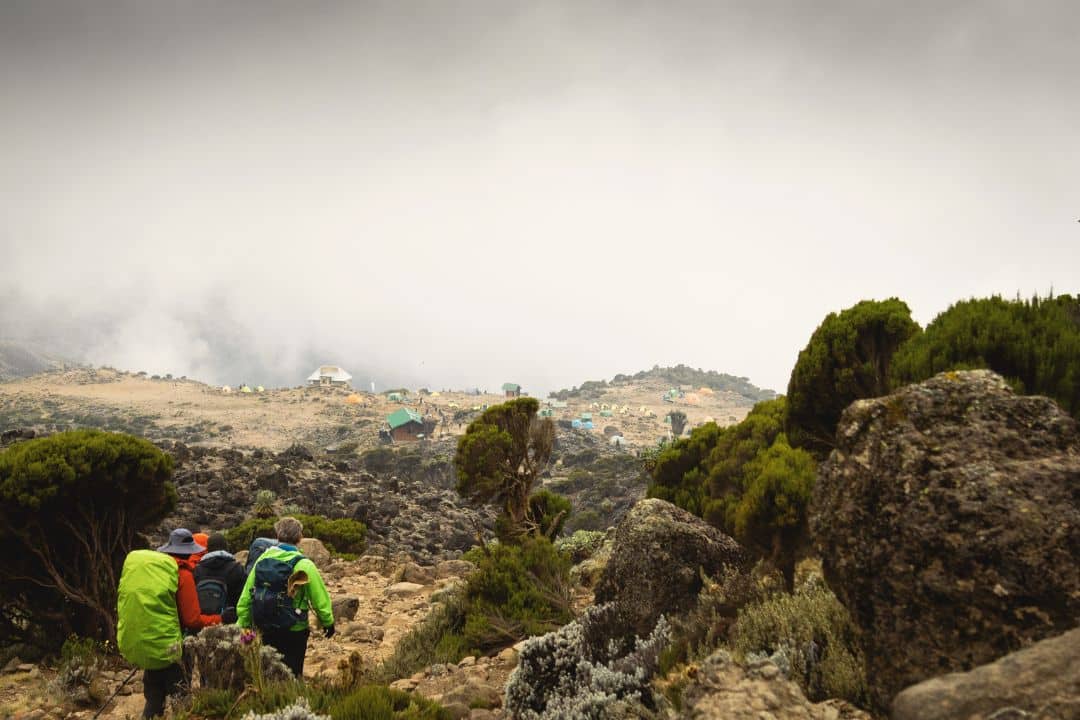
Hikers making their way along the slopes of Mount Kilimanjaro.
5 Facts That Make Mount Kilimanjaro Unique
- This is one of the seven summits.
- Summit success: about 65–75% make it to the top
- The first female climber to reach the peak of Mt Kilimanjaro was Sheila McDonald (Scotland).
- Every year, nearly 3-5 people die on Mount Kilimanjaro.
- The glaciers on Mount Kilimanjaro are nearly 11,700 years old.
Kilimanjaro Climb Questions Answered
Is climbing Kilimanjaro safe?
It is relatively safe when conducted under professional guidance, but altitude sickness is a concern.
How long is the ascent?
6–9 days, depending on route.
When is the best time of year to climb?
The optimal time to go is January–March, June–October.
How many people climb Kilimanjaro annually?
Around 30,000 trekkers.
Why is Kilimanjaro famous?
It is famous for being:
- Africa’s tallest peak
- A UNESCO heritage site
- Fascinating three volcanoes

Mount Kilimanjaro towering above the surrounding landscape.
Why Kilimanjaro Stands Apart
Mount Kilimanjaro stands out as one of the world’s most remarkable natural landmarks. From its wildlife-filled lower slopes to its snow-covered summit, every stage of the journey offers something completely different. It’s not just a climb, but a gradual transition through ecosystems, landscapes, and physical challenges that few places on earth can match.
Whether you’re drawn by the achievement, the scenery, or the experience itself, Kilimanjaro leaves a lasting impression long after the descent.